
CLIENT PROFILE
Josh in motion
Josh laughs easily. Often at himself, sometimes at the absurdity of things, and occasionally at the rest of the world when it moves a little too fast around him.
He is married, has two teenagers at home, works full time in natural landscaping, and spends a surprising amount of his spare time training pigeons. Racing pigeons, to be exact. Around 150 of them. He talks about their training the way athletes talk about seasons, preparation, and marginal gains. Fitness before race time, distance calculations measured down to centimetres, results decided by seconds.
Precision matters to Josh. Routine matters too.
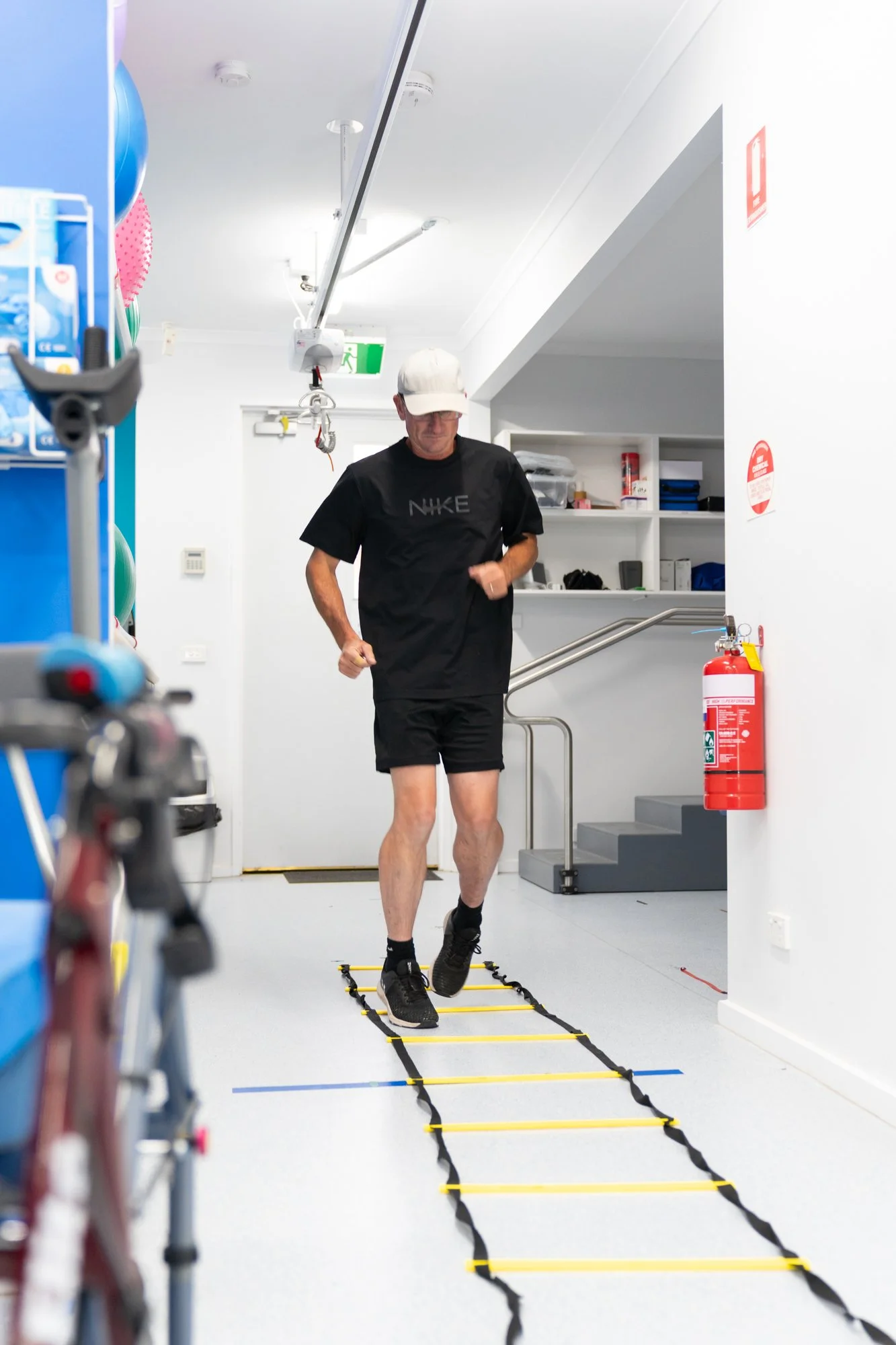
On this particular day, he is midway through an exercise physiology session. The conversation drifts easily between footy, work, family, fires in the western suburbs, and the logistics of moving through crowded spaces when your vision does not quite keep up with the world around you. Every so often, the talk pauses while he jogs, changes direction, or resets for the next exercise.
This rhythm, conversation interrupted by movement, feels fitting.
Josh was born deaf, and later in life, he was diagnosed with Usher syndrome, a rare genetic condition that causes progressive vision loss. About 6 years ago, Josh was also diagnosed with Multiple sclerosis. He talks about these diagnoses plainly. They are facts of his life, not defining moments.
What he notices more are the practical things.
The way people appear suddenly from the side in a supermarket aisle. The importance of a trolley acting as a kind of moving shield. The difference between seeing someone in front of him versus sensing a crowd closing in from all directions. The small calculations that happen constantly, often unnoticed by others.
Before starting therapy, these calculations became exhausting. Walking felt unsafe. Running disappeared entirely. Falls at work became more frequent. Josh became acutely aware of how he looked when he moved and how easily someone might mistake balance changes for something else entirely.
So he stopped doing some things.
He stayed home more. Sat more and let the world come to him.
Exercise physiology entered Josh’s life not as a dramatic intervention, but as a steady presence. A place where movement could be broken down, rebuilt, tested, and tried again. Where falling was not a failure, but information. Where strength, balance, and endurance were worked on slowly and deliberately, week after week.
Josh has continued weekly exercise physiology sessions throughout his rehabilitation, always with his trusted therapist Nikki. Over time, his capacity has expanded. He learned to trust his body again, then to challenge it. Running returned, first cautiously, then with confidence. Swimming followed. Kicking a football with his son became possible again, not because everything was fixed, but because his body could meet the demands placed on it.
What stands out most is not how far Josh can run now, but how he moves through his life.
He goes to football games with his family and navigates crowds with more assurance. He works full time in a physically demanding job. He trains pigeons, sets goals, and talks about the future with quiet certainty rather than hesitation.
Josh is clear about one thing. The consistency matters, being pushed safely and thoughtfully matters and, what matters most of all is having a therapist that you can trust.
Josh’s conditions remain. So does the unpredictability that comes with them. But they no longer take up all the space.
Josh is not chasing a version of himself from before. He is building something that works now, through routine, movement, and a willingness to keep showing up, even when the path is not straight. And in between the running drills, the jokes, and the sideways conversations, that feels like the most important part of his story.